For most of human history, time was entirely local. If you lived in London, York, or Edinburgh, you set your pocket watch to “high noon”—the exact moment the sun reached its highest point in your local sky. Because the Earth rotates continuously, high noon happens a few minutes later for every few miles you travel west.
As long as the fastest mode of transportation was a horse and cart, this localized system worked perfectly. But the arrival of the steam locomotive and the electric telegraph in the 19th century changed everything. Suddenly, a train could cross dozens of towns in a single afternoon, turning local timekeeping into a chaotic web of scheduling collisions.
To prevent logistical collapse, the world had to invent a standardized global grid: the modern time zone system. Here is the ultimate guide to the history, mechanics, and science behind how humanity standardizes time across the globe.
1. Why Do Time Zones Exist? The Railroad Revolution
Before time standardisation, the United States alone had over 300 localized time zones, and the United Kingdom had dozens. A train departing Bristol for London would find its station clocks completely misaligned with the town squares it passed along the way.
To solve this, a Scottish-Canadian engineer named Sir Sandford Fleming pioneered the concept of a worldwide 24-hour time grid in the late 1870s.
The math behind his design was elegant and tied directly to cosmic geometry:
- The Earth takes approximately 24 hours to complete a full 360-degree rotation on its axis.
- If you divide 360 degrees by 24 hours, you get 15 degrees.
- Therefore, the planet could logically be sliced into 24 distinct time zones, each measuring exactly 15 degrees of longitude wide, with each zone representing a precise one-hour shift in time.
2. GMT vs. UTC: What is the Real Difference?
When managing global software or cross-border schedules, people frequently use Greenwich Mean Time (GMT) and Coordinated Universal Time (UTC) interchangeably. However, they are fundamentally different concepts: one is a astronomical time zone, while the other is a high-precision scientific standard.
Greenwich Mean Time (GMT)
In 1884, the International Meridian Conference met in Washington, D.C., to choose a single, universal point of reference for global time tracking. They selected the Royal Observatory in Greenwich, London, as the “Prime Meridian” (0° longitude).
GMT is an astronomical standard based purely on the Earth’s rotation relative to the sun. Under GMT, the clock begins at midnight in Greenwich. However, because the Earth’s rotation is irregular—wobbling slightly due to tidal friction and geological shifts—GMT is not perfectly stable over long periods.
Coordinated Universal Time (UTC)
To create a more stable clock for modern telecommunications, aviation, and computing, scientists introduced UTC in 1961.
Unlike GMT, UTC does not rely on looking at the sun. Instead, it is calculated using ultra-precise atomic clocks maintained by labs worldwide. Because the Earth’s physical rotation slowly desynchronizes from atomic time, scientists occasionally inject a “leap second” into UTC to keep it aligned with the planet’s physical orientation.
- The Takeaway: GMT is a physical time zone used by humans in parts of Europe and Africa. UTC is a technological standard used by servers, databases, and software algorithms to keep global infrastructure perfectly synchronized.
3. How the International Date Line Works
If you travel west across the globe, you wind your watch back one hour for every 15 degrees of longitude you cross. If you keep traveling west indefinitely, you will eventually “lose” 24 hours relative to your starting point.
To fix this chronological paradox, geography requires a boundary line where a full day is added or subtracted. This boundary is the International Date Line (IDL).
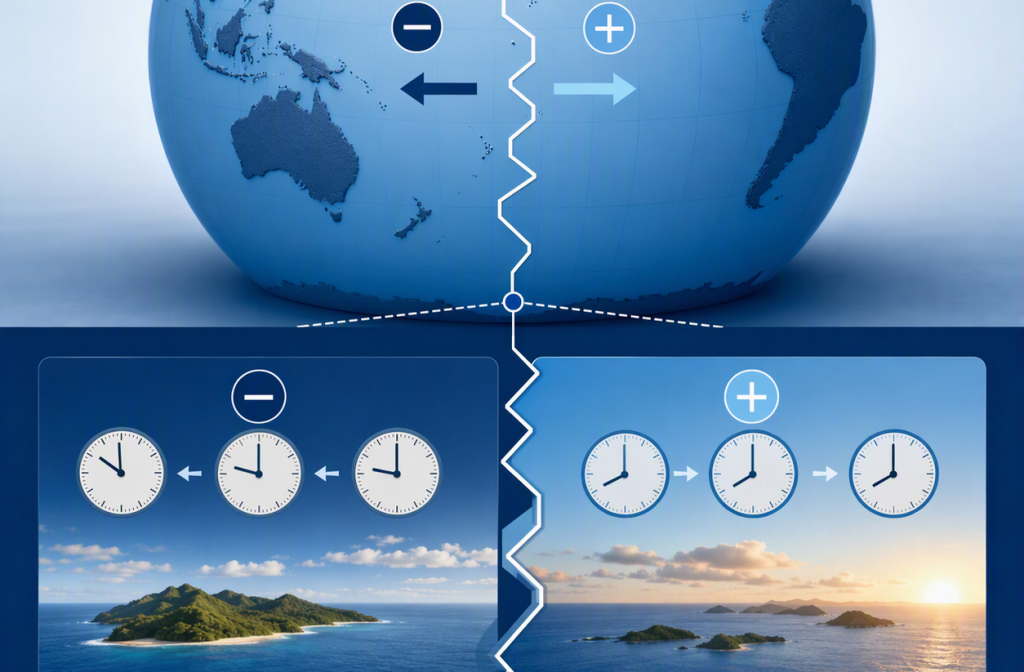
Located halfway around the world from Greenwich at 180° longitude, the IDL runs directly down the middle of the Pacific Ocean. Crossing the line causes a literal jump through time:
- Traveling West (toward Asia): You cross the line and instantly jump forward a full calendar day (e.g., Tuesday becomes Wednesday).
- Traveling East (toward the Americas): You cross the line and jump backward a full calendar day (e.g., Wednesday becomes Tuesday).
The Political Zig-Zags of Time
While the concept of the IDL is mathematically straight, the actual line on a map zig-zags wildly. Because the line splits the ocean, nations get to decide which side of the date line they want to belong to based on their economic partners.
For instance, in 1994, the island nation of Kiribati shifted the line drastically eastward so that its entire chain of islands could share the same calendar day, creating a massive protrusion in the middle of the Pacific. Similarly, Samoa shifted itself across the line in 2011 to align its calendar business days with its primary trading partners, Australia and New Zealand.
4. Modern Anomalies: The Quirks of Political Time
While Sir Sandford Fleming envisioned 24 clean, straight hourly blocks, politics has warped the global map into a complex tapestry of edge cases.
- Half-Hour and Quarter-Hour Offsets: Some countries choose not to align with hourly shifts. India operates entirely on Indian Standard Time (IST, UTC+5:30). Nepal takes it a step further, maintaining an official offset of UTC+5:45 to align precisely with the meridian passing through a sacred local mountain peak.
- China’s Monolithic Zone: Geographically, China spans five distinct hourly time zones. However, the government mandates a single, unified standard: Beijing Time (UTC+8). As a result, in western regions like Xinjiang, the sun routinely rises as late as 10:00 AM during winter.
5. Navigating Time Mechanics in the Digital Age
Understanding these underlying astronomical and mathematical mechanics is essential for anyone operating in our hyper-connected world. Whether you are writing code that parses timestamps, organizing a product launch across multiple hemispheres, or managing a remote workforce, global offsets affect every facet of modern industry.
To easily navigate these complex offsets, visualize your team’s locations, and safely plan meetings across boundaries without falling into time zone math traps, try our interactive Time Zone Scheduler on the homepage.